





DOTSOFT published in Cybersecurity Magazine: practical lessons from a real-world smart parking cybersecurity validation pilot
DOTSOFT experts share the findings of the CASPER validation activity on strengthening cyber resilience in smart city infrastructures.
An article titled “Strengthening Cyber Resilience in Smart City Infrastructures: Practical Lessons from a Real-World Smart Parking Validation Pilot (CASPER)” has been published in the international Cybersecurity Magazine, authored by Anastasios Manos (CEO, DOTSOFT), Despina Elisabeth Filippidou (Head of Innovation & R&D, DOTSOFT) and Panagiotis Paltsokas (AI Engineer, DOTSOFT).
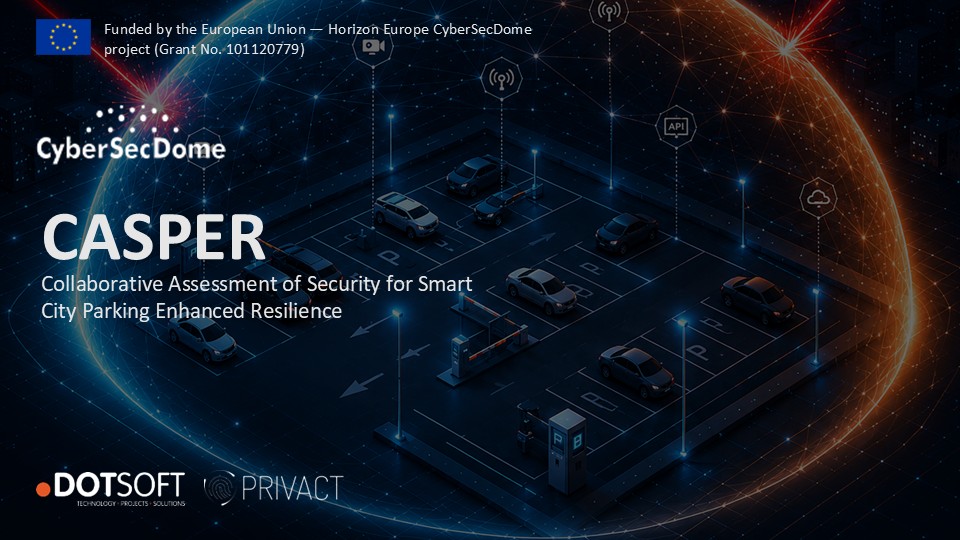
The article presents the practical lessons drawn from the CASPER validation activity, in which the AI-enhanced cybersecurity capabilities of CyberSecDome were assessed in a real-world smart parking environment (the INTEL ANN smart-parking environment).
CASPER was carried out by DOTSOFT and PRIVACT within the CyberSecDome project, funded by the European Union’s Horizon Europe research and innovation programme under Grant Agreement No. 101120779
Why it matters
Smart city infrastructures combine sensors, communication networks, cloud services and citizen-facing applications into complex cyber-physical environments. That interconnection creates new attack surfaces and dependencies: an incident affecting a single component can propagate across the wider operational ecosystem, disrupting services and eroding public trust.
Traditional cybersecurity approaches — focused on individual security controls or isolated technology evaluations — prove insufficient in such settings.
The validation approach
CASPER followed an evidence-oriented approach based on realistic attack scenarios and controlled attack simulations. The activity examined how CyberSecDome capabilities perform together: dynamic risk assessment (DRA), intrusion detection and prevention (IDPS/IPS), automated security testing (ADAPT/DAIR), incident management and investigation (Prophecy/FVT, XAI), collaborative intelligence, knowledge sharing, and situational awareness through advanced visualisation (VR).
Eight attack and stress scenarios were used, including network scanning, brute-force login attempts, SQL injection, API flooding and resource-depletion attacks, unauthorised API access, SYN-flood, and LLM-based PCAP file obfuscation.
Four practical lessons
- Asset visibility matters more than individual tool capabilities. Without a comprehensive inventory of assets, data flows, dependencies and vulnerabilities, even advanced tools produce fragmented results.
- Evidence-oriented validation provides better insight than isolated technical metrics. An alert becomes meaningful when correlated with network evidence, incident artifacts and risk-assessment outputs.
- Controlled attack simulation remains essential for evaluating operational preparedness, surfacing vulnerabilities and enabling early remediation.
- Situational awareness improves decision-making. Advanced visualisation does not replace cybersecurity analysis, but it strengthens operators’ understanding of incidents and their impact — and helps communicate them to C-level executives.
The takeaway
As the authors note, “the combined use of different tools improved the understanding of risks, threats, incidents, and operational impacts.” Cyber resilience cannot be achieved through advanced technologies alone: detection tools and AI techniques deliver value only when connected to risk management, operational visibility, evidence-based validation and human decision support.
DOTSOFT continues to invest in research and in the development of cybersecurity solutions for critical urban infrastructures, translating experience from European research projects into operational practice.
Read the full article in Cybersecurity Magazine: https://cybersecurity-magazine.com/strengthening-cyber-resilience-in-smart-city-infrastructures-practical-lessons-from-a-real-world-smart-parking-validation-pilot-casper/